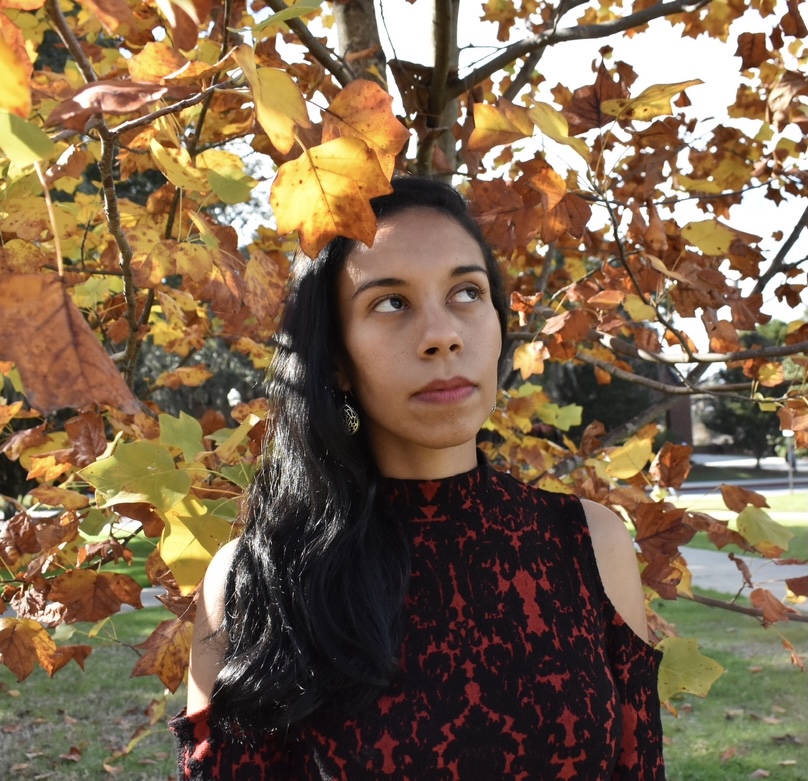

This month we have a special treat for our readers! The current Copyright Specialist in Residence for Copyrightlaws.com, Sierra Marquette Whitfield, is the Copyright and Fair Use Librarian at Texas A&M University. Sierra has a Master of Library and Information Science from Florida State University and is passionate about helping others navigate copyright law with confidence. In this vein, she has put together the article below to explain the current conflict between the United States government and the US Copyright Office. The situation is complex and yet Sierra manages to clarify the various elements in an accessible and thorough way. Enjoy! (Photo Courtesy of Sierra Whitfield)
Who Should the US Copyright Office Answer To?
The current Copyright Specialist in Residence for Copyrightlaws.com, Sierra Marquette Whitfield, is the Copyright and Fair Use Librarian at Texas A&M University. Sierra has a Master of Library and Information Science from Florida State University and is passionate about helping others navigate copyright law with confidence. In this vein, she has put together the article below to explain the current conflict between the United States government and the US Copyright Office. The situation is complex and yet Sierra manages to clarify the various elements in an accessible and thorough way.
Decoupling the U.S. Copyright Office from the Library of Congress wasn’t on anyone’s 2026 policy bingo card — but that’s exactly what’s now in play. In an accelerated timeline (this bill was initially introduced in March 2026), the House of Representatives approved, by voice vote, H.R. 6028, the Legislative Branch Agencies Clarification Act. Among its central provisions, the bill would remove the Library of Congress’s supervisory authority over the Copyright Office, alter the process by which senior officials are appointed, and create a formal structural separation between the two institutions.
A key institutional change proposed by H.R. 6028 is the reassignment of the power to appoint the Register of Copyrights from the Librarian of Congress to the President. The current relationship between the Register of Copyrights and the Librarian of Congress is hierarchical: the U.S. Copyright Office operates as a distinct department within the Library of Congress, and the Register is appointed by, and serves under the general supervision of, the Librarian. Although the Copyright Office manages day-to-day copyright registration and policy work with substantial autonomy, major structural decisions, senior personnel appointments, and budget allocations require the Librarian’s involvement or approval.
A key operational link between the two offices arises from the deposit requirement for registered works. Copies submitted for copyright registration are transferred into the Library of Congress’s collections, tying the administrative process of registration to the Library’s mission of preservation and access.
The offices also collaborate in policymaking, most notably in the triennial rulemaking under Section 1201 of the Digital Millennium Copyright Act (DMCA). Section 1201 bars circumvention of technological protections for copyrighted works. To narrow this broad ban, the Librarian of Congress adopts temporary exemptions every three years. In each cycle, the Copyright Office conducts a public proceeding and the Register of Copyrights issues recommendations, which inform the Librarian’s final rules authorizing time-limited exemptions — for example, for research, device repair and modification, and accessibility uses.
Public-interest advocates argue that making the Register a presidential appointee risks politicizing an office that has historically remained nonpartisan and could further entrench the influence of major private rights holders over copyright policy and administration, often at the expense of the broader public interest. These concerns gain salience considering President Trump’s stated views on copyright and the training of large language models (LLMs) on copyrighted material. At a July 2025 AI summit, he characterized proposals to require technology companies to license or compensate copyright holders for each article, book, or dataset used in training as “unworkable” and “not feasible,” arguing that such obligations would disadvantage U.S. developers relative to competitors in jurisdictions such as China, which do not impose comparable licensing requirements.
President Trump’s second administration has pursued a systematic restructuring of the federal workforce to align executive offices and career personnel with his political agenda, drawing heavily on the unitary executive theory. This theory, rooted in a particular reading of Article II, Section 1 of the U.S. Constitution (“The executive Power shall be vested in a President of the United States of America”), maintains that the President holds exclusive and plenary authority over the entire executive branch. Under this view, the President may direct all executive branch employees, set administrative policy, and remove federal officers at will.
Against this backdrop, the conflict between President Trump and the current Register of Copyrights, Shira Perlmutter, becomes easier to understand. President Trump sought to remove Perlmutter after disagreements arose over a U.S. Copyright Office report on artificial intelligence and copyright. The Office has produced three reports addressing generative AI — two fully published, and one pre-publication report released in May 2025. It is this third pre-publication report that is at issue here. The report concluded that using copyrighted material to train generative AI models may qualify as fair use, but that certain unauthorized commercial training uses — especially those involving pirated material — can exceed fair use’s limits. The administration, by contrast, strongly disagreed with the report’s findings and adopted a legal position in court filings that urged courts to treat model training on copyrighted text, considered on its own, as a highly transformative fair use.
In response, the White House Presidential Personnel Office moved to dismiss Perlmutter. She subsequently filed suit against President Trump and several administration officials. The case ultimately reached the Supreme Court, which declined to grant the administration’s request to remove her. As a result, a lower court injunction remains in effect, allowing Perlmutter to continue serving as Register while her lawsuit proceeds.
Given the administration’s stated objective of securing U.S. leadership in artificial intelligence, as outlined in documents such as “Winning the Race: America’s AI Action Plan,” its posture toward the U.S. Copyright Office is consistent with a broader effort to control policy outputs related to AI. Although the Office’s reports and recommendations are not themselves legally binding, they can influence judicial interpretations if courts rely on them, and they play a significant role in shaping national copyright policy. For an administration that treats rapid AI development as a strategic priority and favors more permissive copyright rules in this area, the impulse to align the Copyright Office’s positions with its own policy vision helps explain these actions.
There are broader implications to shifting the appointment of the Register of Copyrights to the President. The most immediate is the likely politicization of a role that is currently designed to be nonpartisan. As noted above, policy alignment has been a central objective of the Trump Administration. It is therefore reasonable to infer that any presidentially appointed Register would be selected, at least in part, for adherence to the administration’s particular political ideology or economic interpretation of copyright law. This prospect raises concerns about the Register’s existing role in relation to Congress. The Register has two core, formally apolitical functions: administering the registration of copyrightable works and providing expert information on copyright law to the federal government. While presidential appointment would not, as a legal matter, prevent the Register from advising Congress, it would likely alter the locus of the Office’s institutional loyalty and could encourage the promotion of the President’s policy agenda in congressional deliberations.
Term continuity presents a second concern. At present, there are no formal term limits for the Register of Copyrights. Subject to the Librarian of Congress’s discretion, a Register may remain in office indefinitely. Historically, this has allowed Registers to serve across multiple presidential administrations, building deep institutional memory and specialized expertise. Under presidential control, however, leadership could be subject to turnover with each change in the White House, increasing the risk of short tenures and policy volatility.
A third area of concern is the potential for heightened influence by special interest groups. Copyright law affects a wide range of sectors, including the entertainment industry, technology and artificial intelligence, and right-to-repair initiatives. Critics such as the Electronic Frontier Foundation argue that vesting appointment authority in the President would create more direct channels for large trade associations, media conglomerates, and technology companies to lobby the executive branch for leadership choices aligned with their interests, thereby amplifying private influence over public copyright policy.
Taken together, these structural changes and governance risks set the stage for examining the concrete legislative proposals now advancing through Congress and the potential paths forward for the U.S. Copyright Office.
There are two key bills at issue, although one effectively functions as a revised version of the other: H.R. 6028 and H.R. 10204. The initial bill, H.R. 6028, was introduced in the House of Representatives by Rep. H. Morgan Griffith. Approximately six months later, in June 2026, the House passed H.R. 6028 by voice vote under suspension of the rules and transmitted it to the Senate.
Subsequently, an updated “clean” bill, H.R. 10204, was introduced on September 1, 2026. This measure preserves the core substantive provisions of H.R. 6028 while incorporating technical corrections and refinements. Less than two weeks later, on September 14, the House again employed suspension of the rules to pass H.R. 10204 by voice vote and send it to the Senate, where it now joins H.R. 6028.
At present, both versions of the legislation are pending Senate consideration. For the proposed structural changes to take effect as permanent law, the Senate must approve the text, and the President must sign the bill.
For more than a century, the current arrangement has tied copyright administration to an institution whose core mission centers on preservation, access, and nonpartisan expertise. The proposed shift would instead embed copyright leadership within a branch of government that is explicitly political and increasingly oriented toward rapid, strategic policy interventions, including in areas such as artificial intelligence. That reorientation raises fundamental questions about the future neutrality of copyright advice to Congress, the continuity and independence of the Register’s tenure, and the degree to which major private stakeholders can shape the direction of national copyright policy.
As the Senate considers these bills, the central issue is not only who appoints the Register of Copyrights, but what kind of copyright regime the United States will have in the coming decades: one anchored in long-term institutional expertise and a measure of insulation from partisan cycles, or one more closely synchronized with the priorities of whichever administration happens to hold the White House. The outcome of this debate will define the governance of U.S. copyright policy and the relative influence of Congress, the Library of Congress, and the executive branch for years to come.
Thanks, Sierra, for that wonderful overview of a complicated situation! All our Copyright Specialists in Residence, like Sierra, get the opportunity to contribute an article to both our website and one of our newsletters. In addition, they also take part in our Certificate cohorts, presenting a virtual class on the topic of their choice and running the weekly discussion posts on the community space. It’s an excellent chance for participants to grow their network and practice facilitating conversations about copyright-related subjects. Interested in becoming our Specialist for the Fall of 2027? Reach out to us for more information!